Invest in the whole ecosystem, not in individual ventures.
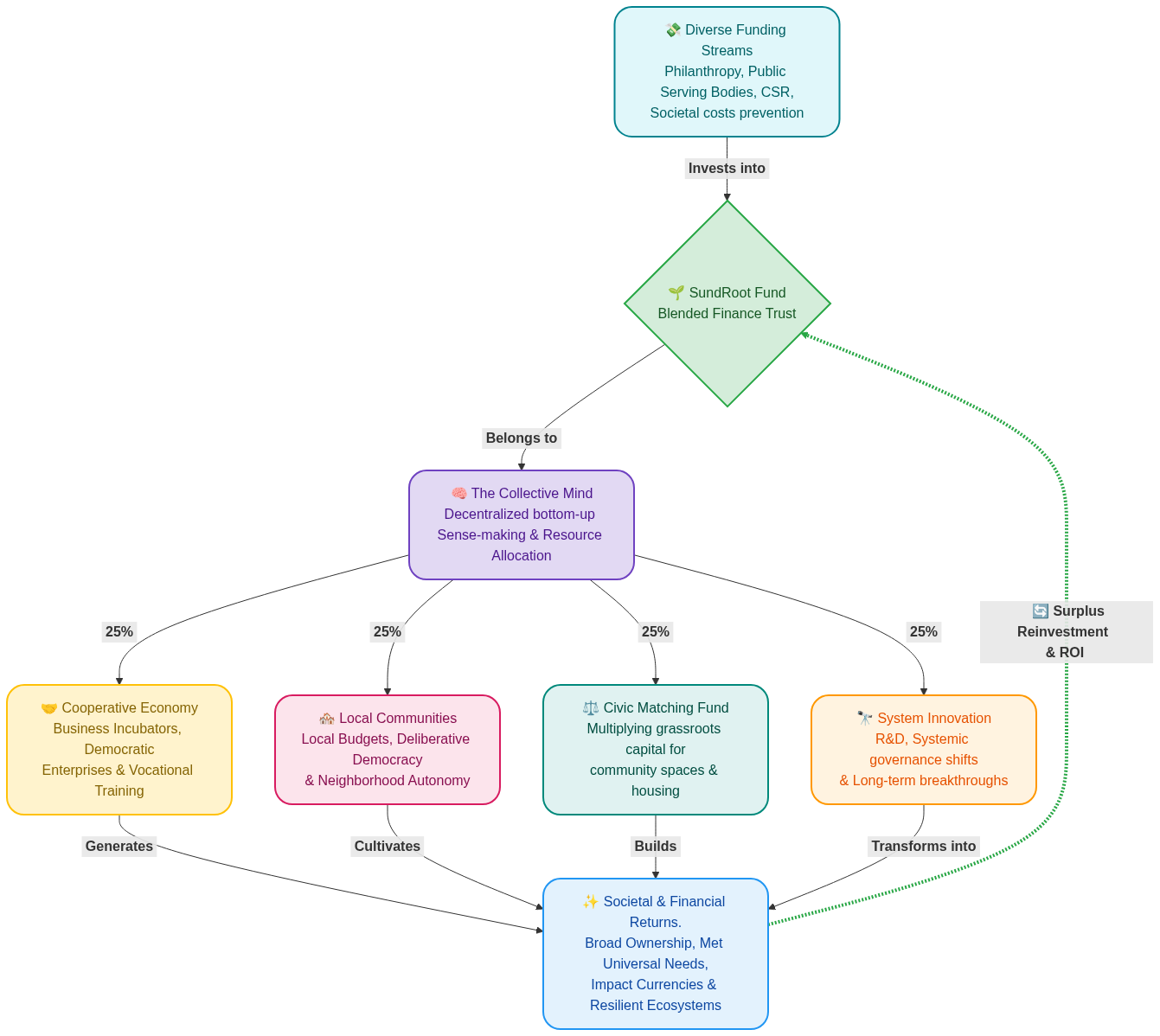
A platform where people and societal actors can invest in the cooperative ecosystem as a whole. The capital does not feed a single project but a living, self-growing economy that optimizes itself through resource sharing — and becomes competitive on an otherwise ruthless market, but with different rules and logics. When financial and societal returns point the same way, massive resources are unlocked to serve the common good.
Holistic ecosystems
The ecosystems are holistic in several ways: in the sectors they cover, in the bottom-up societies that grow, and in how each enterprise and initiative ownership structures and governance is in tune with the whole ecosystem and the world's needs, problems and opportunities.
A future project taking shape
This is a future project that will grow forward step by step — a direction and an invitation rather than a finished product. If it resonates with you, we would love to develop it together. Reach out and let's explore what it could become.
How the model works
Many times you invest in a single venture and hope that one succeeds. Here you invest instead in a whole ecosystem of cooperative enterprises that help each other. They share common services — bookkeeping, IT, design, marketing, legal and more — which lowers costs and risk for everyone. When one part of the ecosystem grows, the whole is strengthened. Surplus flows back into a common fund that reinvests in further development, the startup of more cooperatives, and education. It becomes a reinvestment engine: a chain reaction that makes the ecosystem grow by itself. Returns come from two directions. The actual profits of the cooperative enterprises, and the societal savings the ecosystem creates. SundRoot is exploring a collaboration with effektfullt.org to measure these real effects and claim the value from the societal actors who make the saving, returning it to everyone who invested — alongside the enterprises' profits.
How the capital flows
Savers and investors
Shares like community shares — capped, non-speculative return
Established cooperatives
Existing co-ops get to grow and expand to new industries
New cooperatives
Started in the network or converted from existing companies
Shared services
Bookkeeping, IT, legal, marketing, sales, procurement procedures etc.
Independent impact measurement
Actual societal benefit is verified — a collaboration we want to explore with effektfullt.org
Societal actors
Municipality, healthcare, insurance — those who actually saved money
Two return streams back to the fund and the savers
Financial return
Profit sharing from the cooperatives' operations
Societal return
Verified saving, paid back by the societal actor who saved
The Engine
A chain reaction
Why the whole ecosystem?
Investing in the whole instead of picking individual winners solves three problems at once.
Risk spreading
Risk is automatically spread across the whole portfolio. The ecosystem as a whole responds to challenges to adapt and balance risks across the various actors in the network. Cooperatives have proven to be much more resilient organizations compared to traditional companies. And when they form a network, their resilience and ability to withstand crises become even stronger.
Shared services become economically possible
A bookkeeping or IT service for cooperatives is only viable if it serves many. No single investor would fund such infrastructure for one company. Pooled capital builds the common backbone that makes every enterprise cheaper to run.
Three advantages no lone competitor can match
Lower costs through shared services. Cheaper capital through the fund's reinvestment instead of expensive venture capital. And a safety net in hard times. Three structural advantages a lone extractive actor can never match — no matter how ruthless.
What makes the ecosystem competitive
On an otherwise ruthless market, the network wins through structural advantages a lone actor can never match.
Shared services lower everyone's costs
Bookkeeping, IT, legal, HR — built once, serving all. Every enterprise in the network has lower costs than a lone competitor outside it.
The safety net makes risk manageable
Is an enterprise struggling? The network helps. Must it wind down? Its people are absorbed into other parts of the ecosystem. No one falls through — and that is why more dare to build.
Independent impact measurement — not own claims
Societal effects are to be verified by independent parties — a collaboration we want to explore with effektfullt.org, academia and established methods. What counts is measured, not marketed.
Teams that proactively build — not wait
Incubation, courses and education. Teams are deployed where needs and opportunities exist. The ecosystem does not wait for applications; it cultivates the next enterprise.
Two return streams. One investment.
Financial return
The cooperatives in the ecosystem run real businesses — services, production, trade. A share of the surplus flows back to the fund and its investors. Capped, non-speculative return following the proven community shares model: no one can drain the system, everyone can take part in it.
The cooperatives' operations
Real sales, real customers
Surplus
A share is set aside by statute
Societal return
When a cooperative provides livelihoods, prevents ill health or lifts a neighborhood, real savings arise for municipality, healthcare and insurance. With independent impact measurement — which we want to explore with effektfullt.org — the actors who actually saved money can pay back a share. Prevention becomes an investment with a return, not a cost.
Verified societal effect
Independent impact measurement
Societal actor saves
Municipality, region, insurance
The ecosystem fund
A share of the societal savings flows back
Example calculation
Financial return
1,750 kr
Societal return
2,500 kr
The numbers are illustrative assumptions — not promises or forecasts. The example assumes a modest annual profit share (3.5%) and a share of verified societal savings (5%). Combined 7.5%. A competetive number on the usual market. Actual outcomes depend on how the ecosystem and the impact measurement develop. Another factor to consider is the exponential impact that the ecosystem has over time, as more resources make a greater difference.
The 5% societal-savings share is very conservative in light of established SROI research: experts estimate that high-quality social programs yield a 3:1 to 5:1 benefit-to-cost ratio — every dollar invested creates $3–$5 in social value (Mohn, E., "Social return on investment (SROI)", EBSCO Research Starters, 2023, ebsco.com). The example thus models only a small slice of the total social value created flowing back to the fund and investors — not the full effect.
An accounting system for real-world ripple effects
Today, what actually makes a difference is rarely priced. A core idea is an accounting system that captures the real ripple effects of what the ecosystem does — and pays for what genuinely creates benefit. It does not just measure effects but also rebalances the system by steering resources to where they do the most good. Building such a system is something we want to explore together with effektfullt.org, which can measure effects and link them to the return. Further ahead lies the idea of decentralized technology for an impact token or impact currency that keeps score of created benefit — a shared measure of effect. That is further out in the plans, but it points the direction: making societal benefit measurable, investable and rewarded.
The system creates a coordination layer
When ownership of the systems shifts to those they serve, a common intelligence is freed. Needs, problems and opportunities become visible across the whole ecosystem, and signals about where the benefit is greatest can be picked up. In this way a coordination layer emerges: resources can be allocated where they make the most difference, from the grassroots up. Impact measurement — like the one we want to explore with effektfullt.org — then guides the allocation, instead of wherever short-term returns happen to be highest. This aligns the work with real needs, problems and opportunities, with both global and local priorities, and with common knowledge and effectful solutions — by mobilizing institutions, actors and organizations toward the same goal.
Blended finance
The model is built for blended finance: smart ways of attracting all kinds of capital into the same ecosystem. Philanthropy, risk capital, capital seeking a societal return and more can work together — each with its own risk appetite and its own goal — and together carry what no single form of financing can manage alone. Philanthropy takes the first risk, institutions scale, and public actors harvest the savings.
Every part of the model is already proven — somewhere
The model invents nothing from zero. It brings together mechanisms that have each already worked for decades, at scale, on different continents.
The reinvestment engine
Mondragón, Basque Country
80,000 worker-owners, over 100 cooperatives. Its own bank pools savings and finances the next cooperative. Internal safety net. Nearly 70 years of proof.
Since 1956
Ordinary people's capital
Community Shares, UK
Over 500 businesses funded by thousands of small savers — shops, pubs, energy. 92% of the businesses still operating. One vote per member, not per pound.
Co-operatives UK
Societal saving as return
Outcome contracts, health
Preventive asthma care in Fresno: fewer ER visits, thousands of dollars saved per child — and the saving repays the investors. Prevention became profitable.
Social impact bonds, USA/UK/SE
Effects as currency
Grassroots Economics, Kenya
Community currencies backed by real local productive capacity — not debt. Over a decade in operation. The model SundRoot is now adapting to Malmö.
grassecon.org
Anchor institutions
Evergreen, Cleveland
Hospitals and universities direct their procurement to local worker cooperatives. Billions in purchasing power that used to leave the city — stays and builds it.
Cleveland Model
Incentives that work
Employee Ownership Trusts, UK
From zero to 2,500 employee-owned companies in ten years — 560 new in 2024 alone. The right incentives at ownership transitions move whole companies into common ownership.
UK Finance Act 2014
How it differs from ordinary investing
This is different. You do good, you see tangible results in your own surroundings, and you can receive a financial return — all at once. But it differs from shareholder-interest investing, where capital gets the power to steer everything toward profit maximization. You do not buy such controlling rights here. Ownership and governance stay with those the enterprise actually serves. The return is capped and non-speculative, following proven community shares logic: no one can drain the system, everyone can take part in it. The logic is simple: Common ownership → Common Sense Governance → Common Good.
Different capital. Different roles. Same engine.
Every kind of capital and engagement finds its place in the ecosystem. Choose your perspective.
Philanthropy & foundations
Project grants often vanish without a trace. Here your contribution takes the first risk — and instead of being consumed it becomes permanent infrastructure that keeps working decade after decade. Catalytic capital in the true sense: your crown unlocks the others'.
What you get
- Your contribution multiplies — reinvested in wave after wave of enterprises
- Transparent in real time via Open Collective — see exactly where every crown goes
- Verified effect through independent measurement, not self-reported numbers
- Your contribution builds the engine — not yet another project that ends
Governance through common sense
The ecosystem is governed by those it serves, with a holistic view of needs, problems, solutions and opportunities. Resources are allocated effectively and continuously to what actually makes a difference — not to where short-term returns happen to be highest. That is why the model can serve the common good: because it is governed by common sense, not by profit priority.
The engine is being built now. The question is what role you take in it.
SundRoot is early in its journey and is building the foundations for a democratic economy. The first enterprises are already moving in Malmö. We are open to collaboration with authorities, civil society, organizations, businesses, philanthropists and people who want to contribute to effective and lasting societal change. Support and follow the fund openly on Open Collective .